Saturday, June 22, 2013

Summer Schedule


Sorry for the delay between posts; it was an intense finish to the school year.  I will be away at times this summer, however I will continue to post updates to the blog.  Thanks for following the blog this year and I hope you keep checking back this summer.

I was thinking of what to post today.  As I indicated, it was a particularly intense finish to this school year.  As a result I'm behind on all of my reading, not just for science.  I was contacting my state senator when I noticed this short video on the NYS Senate website.  What better way to begin the summer by giving thanks to our gracious God and for being fortunate enough (blessed enough) to be born and live in our great nation. But of course, how could we not give thanks to the many men and women of our armed forces who have had such an indelible effect on our comfortable lives: freedom to worship (although that is under attack by our President Obama), freedom to vote, freedom to move about as we wish, and so on - there are far too many to list here.

So as we begin this summer, let us all give thanks to our veterans, living and deceased.  Without their sacrifices, we would not be able to enjoy our lives as we do.  If you know a veteran, say, "Thank you for your service and sacrifice."  If you knew a deceased veteran, say a grandfather who fought in "The Great War," pay your respects at his grave.  Give thanks, give thanks, give thanks.

If this short video below from State Senator Dean Skelos doesn't arouse your pride in being a citizen of this great nation and bring a tear to your eye, I don't know what will.

Prayers and blessings for a safe and restful summer vacation.
- - Bro. Benjamin


Monday, June 10, 2013

The Big Bang

Here's a fascinating article from the W.M. Keck Observatory in Hawaii.  This observatory is home to the two largest telescopes on earth - the twin 10-meter Keck Telescopes.

W. M. Keck Observatory Homepage

International Team on Keck Observatory Strengthens Big Bang Theory

June 5, 2013
Kamuela, Hawaii – An international team of scientists using the most powerful telescope on Earth has discovered the moments just after the Big Bang happened more like the theory predicts, eliminating a significant discrepancy that troubled physicists for two decades. The discovery will be published in the international journal Astronomy & Astrophysics on June 6.
One of the most important problems in physics and astronomy was the inconsistency between the lithium isotopes previously observed in the oldest stars in our galaxy, which suggested levels about two hundred times more Li-6 and about three to five time less Li-7 than Big Bang nucleosynthesis predicts. This serious problem in our understanding of the early Universe has invoked exotic physics and fruitless searches for pre-galactic production sources to reconcile the differences.
The team, led by Karin Lind of the University of Cambridge, has proven the decades-old inventory relied on lower quality observational data with analysis using several simplifications that resulted in spurious detections of lithium isotopes.
Using observations of ancient stars with W. M. Keck Observatory’s 10-meter telescope and state-of-the-art models of their atmospheres has shown that there is no conflict between their lithium-6 and lithium-7 content and predictions of the standard theory of Big Bang nucleosynthesis, restoring thus the order in our theory of the early universe.
The discovery that the universe was expanding by Edwin Hubble in the 1920s and subsequent observations suggest the universe began about 13.8 billion years ago in an event called the Big Bang. The fundamental observations that corroborate the Big Bang are the cosmic microwave radiation and the chemical abundances of the light elements described in the Big Bang nucleosynthesis theory.
“The predictions of Big Bang nucleosynthesis have been one of the main successes of the standard Big Bang model,” said lead author Lind. “Our findings remove much of the stark tension between 6Li and 7Li abundances in stars and standard BBN, even opening up the door for a full reconciliation. This further consolidates a model resting heavily on the pillars of the cosmic microwave background and the expanding Universe.”
Taking accurate measurements of lithium-6 and lithium-7 in old stars is extremely challenging, both from a theoretical and observational perspective, in particular for lithium-6, because being the less abundant isotope of lithium, its signature is very weak. The required data can only be obtained with the largest telescopes on Earth such as the Keck Observatory on the summit of Mauna Kea, Hawaii equipped with the powerful High Resolution Echelle Spectrometer (HIRES) spectrograph to disperse the stellar light into its constituent colors and absorption features.
“Back in 2004 HIRES was upgraded with CCDs having smaller pixels, allowing to see finer details in the spectrum,” University of Sao Paulo’s Jorge Meléndez said. “A high spectral resolution provided by HIRES is needed to study with exquisite detail the line profile and to estimate the presence of Lithium-6. The large light-collecting power of Keck Observatory allowed us to observe stars with a more ‘pristine’ composition than any previous study.”
Even with the mighty Keck I telescope, a single star must be observed for several hours to gather enough photons for a detailed observation. The modeling of such data is also very demanding, as different processes in the atmospheres of such metal-deficient old stars may mimic the presence of lithium-6. The data must be analyzed using sophisticated model atmospheres created by the team in 3D and included complex calculations that run for weeks on powerful super computers.
“We simultaneously relaxed two key physical assumptions in the modeling of stellar atmospheres; one-dimensional hydrostatic and local thermodynamic equilibrium,” Lind said. “Using more sophisticated physics and powerful super-computers, we managed to remove the systematic biases that plague traditional modeling and have previously led to false identifications of the 6Li/7Li isotopic signature.”
The synergy of high quality Keck observations and detailed theoretical modeling has solved cosmological problems that haunted particle physicists and astrophysicists during the last two decades.
“Understanding the birth of our Universe is pivotal for the understanding of the later formation of all its constituents, ourselves included,” Lind said. “The Big Bang model sets the initial conditions for structure formation and explains our presence in an expanding universe dominated by dark matter and energy.”
The Big Bang theory now rests on more firm footing.
-30-
The international team of astronomers includes Karin Lind (formerly at the Max Planck Institute for Astrophysics [MPA], Germany, and now in Cambridge), Jorge Meléndez (Department of Astronomy, University of Sao Paulo, Brazil), Martin Asplund, Remo Collet (both at the Australian National University, Australia) and Zazralt Magic (MPA). Reference Lind K., Melendez J., Asplund M., Collet R. & Magic Z., The lithium isotopic ratio in very metal-poor stars, Astronomy & Astrophysics.
The W. M. Keck Observatory operates the largest, most scientifically productive telescopes on Earth. The two, 10-meter optical/infrared telescopes on the summit of Mauna Kea on the Island of Hawaii feature a suite of advanced instruments including imagers, multi-object spectrographs, high-resolution spectrographs, integral-field spectroscopy and a world-leading laser guide star adaptive optics system. The Observatory is a private 501(c) 3 non-profit organization and a scientific partnership of the California Institute of Technology, the University of California and NASA.

Monday, May 27, 2013

Memorial Day, 2013

Gentlemen,

Let's not forget why we today is a day off from school.  Let's not forget who the real heroes are.

May God continue to bless this great nation.


Memorial Day and the “Shepherd in Combat Boots”


U.S. Army chaplain Father Emil Joseph Kapaun, who died May 23, 1951, in a North Korean prisoner of war camp, is pictured celebrating Mass from the hood of a jeep Oct. 7, 1950, in South Korea. He was captured about a month later. The Medal of Honor, the nation’s highest military award for bravery, was awarded to the priest posthumously at the White House April 11, 2013. (CNS photo/courtesy U.S. Army medic Raymond Skeehan)

For many, Memorial Day marks the unofficial start of summer, a day of rest to spend with family and friends. But for all Americans, this should be a time to remember the sacrifice of those men and women who, in the words of President Lincoln, “gave the last full measure of devotion,” sacrificing their lives to preserve our freedom. Masses will be celebrated today at theCatholic cemeteries of the Archdiocese of Washington, to remember those who died in service to the nation, and to pray for loved ones who died this past year.

“No one has greater love than this – to lay down one’s life for one’s friend” (John 15:13). In recent weeks, Father Emil Kapaun – a Korean War chaplain who embodied those words – was remembered and honored in both a White House ceremony and at an outdoor Mass at Saint Jude Regional Catholic School in Rockville, Maryland.

Father Kapaun died on May 23, 1951, in a prisoner of war camp in North Korea, and he was buried in an unmarked grave. But his faith and his courage were never forgotten, especially not by the soldiers to whom he ministered on the battlefield and in the prison camp.

This man, remembered as “the shepherd in combat boots,” grew up on a family farm outside of Wichita, Kansas. After serving as a chaplain in World War II, he became a small-town parish priest back home. When the Korean War broke out, he again became an Army chaplain, and his regiment was one of the first sent into combat.

The soft-spoken priest soon became known for the Masses he celebrated on the hoods of Jeeps. He also rode an old bicycle to the front lines to minister to soldiers, and earned a Bronze Star for dodging machine gun fire and dragging wounded troops to safety.

Later, Father Kapaun ignored an evacuation order, opting instead to stay with wounded troops who were subsequently captured by the Chinese and North Korean forces that surrounded them. After helping a wounded Chinese officer, he stopped another Chinese soldier from executing a wounded American soldier, Herb Miller. Father Kapaun carried Miller on his back and helped him walk as the men were forced to make a long death march to a prison camp.

At the camp, Father Kapaun became a parish priest for the prisoners of war there, using his farm skills to get them sanitary drinking water and sneak them food. He prayed the rosary and gave hope to prisoners of all different faiths. A fellow prisoner later said the priest could turn a mud hut into a cathedral.

The guards saw the opportunity to rid themselves of Father Kapaun when he became ill, so he was taken to an isolated hut to die. He blessed his guards, repeating the words of Jesus on the cross, “Father forgive them.” He told his fellow soldiers not to worry, “I’m going to where I always wanted to go.” A few days later, he died in that death house.

Those fellow soldiers helped collect money after the war to establish Kapaun Mount Carmel Catholic High School in Wichita. In 2001, a bronze statue showing the priest helping a wounded soldier to his feet was dedicated at the priest’s hometown parish, Saint John Nepomucene Catholic Church in Pilsen, Kansas, where the cause for his canonization was later opened in 2008.

Father Kapaun was posthumously awarded the nation’s highest military honor, the Medal of Honor, on April 11. President Obama noted that when the Korean War ended 60 years ago, a group of POWs emerged carrying a four-foot cross they had fashioned out of firewood, with radio wire as a crown of thorns, to honor their priest, Father Kapaun. Some of those men, including Herb Miller, attended the White House ceremony.

“This is the valor we honor today – an American soldier who didn’t fire a gun, but who wielded the mightiest weapon of all, a love for his brothers so pure that he was willing to die so they might live,” President Obama said.

Earlier this month, Father Paul Lee, the pastor of the Shrine of Saint Jude Parish in Rockville, whose family was among the refugees who fled from Communist North Korea, celebrated an outdoor Mass on the hood of a Jeep for the students of Saint Jude School so they would remember the faith and sacrifice of this heroic priest.

This Memorial Day is a special time of prayer and remembrance, for Father Kapaun and for all those who have died to preserve our freedom. At a time when our freedom of conscience is increasingly challenged by government actions, we should stop to pray and thank God for their sacrifice, and resolve to stand up for the freedoms for which they gave their lives. One hundred and fifty years ago at Gettysburg, President Lincoln urged us to honor our military dead by taking up “the unfinished work” of safeguarding our freedom. That is our responsibility as Americans, this Memorial Day and every day.

Tuesday, May 21, 2013

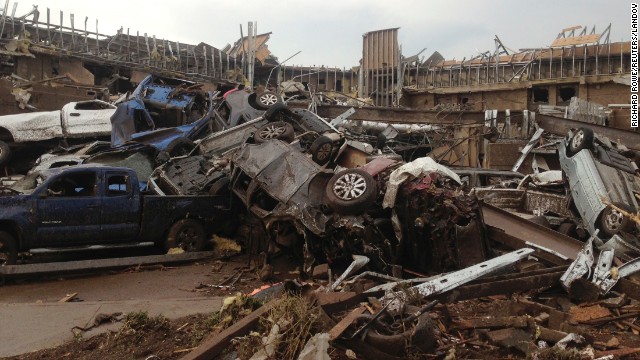
Pray for the people of Moore, OK


The image above is of the entrance to what's left of the Moore, OK, hospital.

Remember the people Moore, OK, in your prayers.  They certainly need them.  And hope we never have to deal with a tornado of this magnitude.

Lots of good articles along with intense images and video of the massive EF-4 (preliminary) tornado.   Weather Underground's News Page

More good articles, etc.    Accuweather.com's News Page

Sunday, May 19, 2013

Drought-Busting


The severe drought continues to affect significant portions of the Plains States.  NOAA's Climate Team put together an excellent short video on the slight drought improvements seen in some parts of the plains.  We here in the "water-rich" portion of the Eastern United States need to insure we don't take for granted the water that we enjoy so much.


Here's the link to the US Drought Monitoring website:US Drought Monitor

Thursday, May 16, 2013

Fire Torandoes

As we approach the summer wildfire season here in the United States, I thought this photo essay from National Geographic on fire tornadoes was rather timely.

Click on the link to get to the article:
National Geographic article

Thursday, May 9, 2013

Hanford Washington (state) - the most polluted place in the US?

Long viewed as one of the most, if not the most, polluted places in the United States, cleanup at the Hanford, WA, nuclear site has slowed to a crawl.  I remember first reading about Hanford during high school via a Scientific American article.  Government beaurocracy and waste are once again on display.

Hanford Site article (Wikipedia) - https://en.wikipedia.org/wiki/Hanford_Site

Continue on the the lengthy eye-popping article below (article from SCIENTIFIC AMERICAN online).


Hanford Nuclear Waste Cleanup Plant May Be Too Dangerous

Safety issues make plans to clean up a mess left over from the construction of the U.S. nuclear arsenal uncertain


VIT PLANT: Even as the new facility to deal with the radioactive legacy of the Hanford Site is built, some critics have questioned its ability to handle the cleanup.Image: Courtesy of Bechtel

More In This Article

The most toxic and voluminous nuclear waste in the U.S.—208 million liters —sits in decaying underground tanks at the Hanford Site (a nuclear reservation) in southeastern Washington State. It accumulated there from the middle of World War II, when the Manhattan Project invented the first nuclear weapon, to 1987, when the last reactor shut down. The federal government’s current attempt at a permanent solution for safely storing that waste for centuries—the Waste Treatment and Immobilization Plant here—has hit a major snag in the form of potential chain reactions, hydrogen explosions and leaks from metal corrosion. And the revelation last February that six more of the storage tanks are currently leaking has further ramped up the pressure for resolution.
After decades of research, experimentation and political inertia, the U.S. Department of Energy (DoE) started building the “Vit Plant” at Hanford in 2000. It’s intended to sequester the waste in stainless steel–encased glass logs, a process known as vitrification (hence “Vit”), so it cannot escape into the environment, barring natural disasters like earthquakes or catastrophic fires. But progress on the plant slowed to a crawl last August, when numerous interested parties acknowledged that the plant’s design might present serious safety risks. In response, then-Energy Secretary Steven Chu appointed an expert panel to find a way forward. Because 60 of the 177 underground tanks have already leaked and all are at increasing risk to do so, solving the problem is urgent.
Vitrification prep 101: Some tough homework
The plant’s construction, currently contracted by the DoE to Bechtel National, Inc., may be the most complicated engineering project underway in the U.S. But back in 2000 the DoE and Bechtel decided to save time and money by starting construction before crucial structures and processes had been designed and properly tested at a scale comparable to full operation. This wasn’t such a good idea, says Dirk Dunning, nuclear material specialist with the Oregon Department of Energy. “The worst possible time to save money is at the beginning. You’re better off to be very nearly complete on design before you begin construction.”
The vitrification project calls for the waste to be analyzed chemically and radiologically before it enters a pretreatment facility to be separated into various constituents such as cesium 137, strontium 90 and metals. After that, each separate waste stream is channeled as either high-level or low-activity waste into designated melters. The glass is created by mixing sand with a few additives like boron; the waste is stirred in, and the whole mess is melted, then decanted into the steel canisters. After the glass logs solidify the waste is trapped and should be isolated from the environment for long enough for most of the radioactivity to decay to safe levels.
The low-level waste canisters will be stored permanently at Hanford. Because the planned Yucca Mountain geologic repository project was halted by the Obama administration, the high-level waste canisters will be kept at Hanford in an as-yet unconstructed building. In January the DoE announced it is beginning work on a new “comprehensive management and disposal system” that will make a permanent geologic repository available by 2048. Yet even if all goes perfectly from now on, it will take until 2062 to vitrify all the waste.
The waste presents significant challenges for Vit Plant project engineers and nuclear chemists. For one thing, the waste varies wildly from tank to tank. The former nuclear weapons facility at Savannah River, Ga.—also part of the Manhattan Project—has been successfully vitrifying weapons waste for years, but only one fuel separation process was used there. At Hanford there were nine production reactors making plutonium and uranium fuel using at least six different radiochemical processes whose chemistry, and thus constituents, were very different. This remains true of the waste as well. There are large differences in composition from tank to tank that necessitate chemically profiling the waste in batches before it enters the Vit Plant, which may also require changes to the glass formula at the other end of the process.


Overall, the tanks hold every element in the periodic table, including half a ton of plutonium, various uranium isotopes and at least 44 other radionuclides—containing a total of about 176 million curies of radioactivity. This is almost twice the radioactivity released at Chernobyl, according to Plutopia: Nuclear Families, Atomic Cities, and the Great Soviet and American Plutonium Disasters, by Kate Brown, a history professor at the University of Maryland, Baltimore County. The waste is also physically hot as well as laced with numerous toxic and corrosive chemicals and heavy metals that threaten the integrity of the pipes and tanks carrying the waste, risking leakage.
The physical form of the waste causes problems, too. It’s very difficult to get a representative sample from any given tank because the waste has settled into layers, starting with a baked-on “hard heal” at the bottom, a layer of salt cake above that, a layer of gooey sludge, then fluid, and finally gases in the headspace between the fluid and the ceiling. Most of the radioactivity is in the solids and sludge whereas most of the volume is in the liquids and the salt cake.
Going with the flow
All of these considerations contribute to the overall problem, which can be summed up in one word: flow. To get to the glass log stage the waste has to travel through an immense labyrinth of tanks and pipes. It has to move at a fast enough clip to avoid pipe and filter clogs as well as prevent solids from settling. This is quite a challenge given the multiphasic nature of the waste: solids, liquids, sludge and gases all move differently. The waste feed through the system will be in the form of a “non-Newtonian slurry”—a mixture of fluids and solids of many different shapes, sizes and densities. If the solids stop moving, problems ensue.
For one thing, there’s a chance that enough plutonium could congregate to trigger a nuclear chain reaction, or criticality—the self-sustaining cascade of atomic fission that releases massive amounts of energy. That would be a serious event even if an explosion did not breach the concrete containment building. Hot slurry could surge backward through the piping, spreading the problem to other parts of the system. Waste solids could also clog pipes, along with ion-exchange filters designed to grab the most radioactive constituents from the low-level waste for addition to the high-level stream.
Whether the solids pile up in the vessels, the pipes or the filters, says Donna Busche, nuclear and environmental safety manager for Hanford contractor URS Corp., “that’s where I’ve got the problem.” Further construction of the Vit Plant’s flawed components cannot proceed unless Busche issues an operating permit, which she is loath to do. She calls the DoE’s failure to require that Bechtel resolve the safety issues sooner “obscene.”
A second explosive risk could arise because both heat and radiation can disassemble water into oxygen and hydrogen. If there are not places along the piping and in the vessels for hydrogen to exit the flow of waste, enough could build up to explode.
And then there’s the extreme radioactivity of the waste, which is far too high for direct human exposure. Enter the Vit Plant’s notorious “black cells.” These are 18 massive concrete enclosures populated by smaller stainless steel vessels. The idea is to guide the waste through the vessels without any human intervention over the 40 years officials believe it will take to process all the waste. The only way to do this is to ensure that the black cells have no moving parts. But because the waste has to be constantly stirred to prevent settling of the noxious and radioactive solids, the plan calls for pulse jet mixers—described as “turkey basters”—to keep the solids suspended.


The pulse jet mixers suck waste into their vertical tubes and then eject it forcefully back into the tanks. Unfortunately, they have not yet been shown to provide sufficient mixing at the scale necessary for the Vit Plant. They do, however, apply enough force to the slurry for the solids to grind away at the stainless steel of tanks and pipes, weakening them enough to risk leakage. Besides this erosion, there’s also potential for chemical corrosion. The Defense Nuclear Safety Board, which advises the White House, has called these problems “a show-stopper.”
“The way [the plant] is currently designed poses unacceptable risks. DoE now admits that,” says Tom Carpenter, executive director of the watchdog group Hanford Challenge. In December the Government Accountability Office issued a highly critical analysis of the Vit Plant’s unresolved safety issues
Disagreements over the safety risks have also prompted outspoken protests from several senior Hanford officials. Chief project engineer Gary Brunson resigned in January. Busche and former deputy chief process engineer Walter Tamosaitis filed whistleblower complaints alleging that their concerns about safety were suppressed by Bechtel. (Bechtel declined to be interviewed for this story, citing nondisclosure agreements signed with Chu’s expert panel.)
But Langdon Holton, DoE’s senior technical authority for the Vit Plant and a member of Chu’s expert panel, believes the project’s problems are technical snags, rather than the insoluble consequence of incompetence or hubris. He also thinks that although the current risks are real, they are unlikely and would be of low magnitude if they did occur. For example, he says, “You’d have to have a vessel unmixed for half a year” for enough hydrogen to accumulate for a significant explosion. “Do I have concern we won’t be able to resolve the issues? No, but it will take some time,” he adds. (Chu’s panel does not expect to issue a formal report, according to Holton.)
Time may be limited. The 177 tanks, built between 1943 and 1986 and most intended for only about a 20-year life span, are decaying; at last count, six are leaking. The Vit Plant was supposed to start operating in 2007 and is now projected to begin in 2022. Its original budget was $4.3 billion and is now estimated at $13.4 billion. Nobody is suggesting the project be abandoned, yet forging ahead without confidence in the plant’s safe operation is not really an option either. The real question, many Hanford watchers say, is whether the country wants to pay for doing it right.
Busche is adamant that the safety issues must be solved before plans proceed further. “The level of robustness we have to put in all our systems is derived from the waste itself,” she says. “It’s the gift that keeps giving until it’s in a glass log.”