Wednesday, June 20, 2012

Heat Wave!

Pardon the bad pun connecting today's and tomorrow's mini-heat-wave and global warming/climate change. Whatever your informed opinion on the matter (climate change), the article below elaborates on a noble goal of the world's megacity-mayors.


Megacities Slash Greenhouse Gases, Share Best Practices
RIO de JANEIRO, Brazil, June 19, 2012 (ENS) - Mayors of the world's megacities today announced that the existing actions of the cities in their organization, the C40 Cities Climate Leadership Group, will reduce greenhouse gas emissions by 248 million tonnes a year by 2020.
Based on new data released today, the mayors said the annual reduction could amount to more than one billion tonnes by 2030, equivalent to the annual greenhouse gas emissions of Mexico and Canada combined.
The announcement was made by Rio de Janeiro Mayor Eduardo Paes and C40 Cities Chairman New York Mayor Michael Bloomberg during the organization's annual meeting, taking place parallel to the UN's sustainable development summit, Rio+20, which is happening in the city all week.
C40 Cities mayors in Rio, from left: Lagos Mayor Babatunde Fashola, Johannesburg Mayor Mpho Franklyn Tau, New York Mayor Michael Bloomberg, Rio Mayor Eduardo Paes, Buenos Aires Mayor Mauricio Macri, Sao Paulo Mayor Gilberto Kassab, June 19, 2012. (Photo courtesy C40 Cities)
"I am encouraged that we, as mayors and citizens, are implementing plans to promote change and reduce carbon emissions in an effort to halt climate change," said Mayor Paes. "When mobilized as one, cities wield sufficient collective power to influence opinion and nudge policy further up the legislative agenda."
"Cities have more freedom than nation states to put into place progressive strategies that are already changing people's lives and today's announcement is testament to the action and unity that is thriving at a municipal level around the globe," the Rio mayor said.
C40 Cities includes 58 of the world's largest cities. Inhabited by one in every 12 people on Earth, they account for approximately 14 percent of global greenhouse gas emissions, according to recent reports by the Carbon Disclosure Project and the UK-based consulting firm Arup.
The C40 mayors today announced two new initiatives.
First, C40 Cities will establish a new solid waste peer-to-peer learning network to assist local governments to reduce methane emissions through solid waste management.
Methane is a greenhouse gas with many times the potency of carbon dioxide, the most abundant greenhouse gas. Landfill methane can be collected and used to generate electricity, as a fuel for industrial purposes, or enriched and sold to gas pipelines.
With support from the World Bank and the Climate and Clean Air Initiative of the U.S. State Department, C40 partners will provide technical assistance to help cities cut methane gas production.
"Mayors and cities don't have the luxury of just sitting around and talking about problems because on a whole range of critical issues, the buck stops at City Hall," said Mayor Bloomberg. "Because of mayors' commitment to action, cities are making great progress in reducing greenhouse gases, which helps beat back climate change and makes our cities better, more liveable places. The data we are releasing today is more evidence that cities have been and will continue to lead the way."
Rio de Janeiro, population 6.3 million, is Brazil's second largest city, after Sao Paulo. (Photo by arigerdes)
C40 cities have undertaken 4,734 climate-related actions since the network was formed in 2005. Research by the Carbon Disclosure Project shows that cities are financing many of their climate change actions without external support, as 64 percent of city initiatives are funded through general municipal funds.
In Rio, the mayors are calling on national governments and international organizations to provide more financing and policy support for local climate actions.
Second, the mayors announced today that the best practices of all C40 Cities will now be shared with the world through a new library on the newly launched C40 website: www.C40.org.
The sharing of best practices started 18 months ago as the Joint Initiative on Urban Sustainability, a pilot exchange program between the C40 cities of Rio and Philadelphia, Pennsylvania, conducted with the support of the U.S. Environmental Protection Agency. Philadelphia Mayor Michael Nutter this week was named president of the U.S. Conference of Mayors.
Governor of Jakarta Fauzi Bowo welcomed the two initiatives, saying, "Any partnership which allows sharing of knowledge and best practices aiming to fight climate change is crucial in order that greenhouse gas emissions are reduced."
"Different cities face different challenges in confronting climate change," said Governor Bowo. "The basic approach Jakarta has taken in reducing greenhouse gas emissions has been a holistic approach based on the basic policy implemented in managing Jakarta, which is pro-poor, pro-jobs, pro growth and pro-environment. These four factors cannot be separated from each other."
The C40 Cities Climate Leadership Group works in partnership with the Clinton Climate Initiative, a program of the William J. Clinton Foundation.
Former U.S. President Bill Clinton, a founding C40 Cities partner, joined today's event by videoconference.
"My foundation has been working since 2006 with the mayors of many large cities around the world to help them reduce their greenhouse gas emissions," Clinton said. "Today's announcements prove that, through creative partnerships, we can help reduce our carbon output to protect our environment and create jobs to grow our economies."

Sunday, June 17, 2012

They Keep Going, And Going, And Going...

NASA's Voyager probes continue their trek through the outermost reaches of our solar system.  However, recent data point to their nearing the edge of our sun's region of influence.  The limit of our sun's influence is called the heliosheath; this is where our sun's solar wind collides with interstellar solar winds.  Voyager 1 has traveled about 9.1 billion miles!

The article in ScienceDaily.com appears below.  Here is the link to the article on the NASA website:
NASA Voyager Article


Data from NASA's Voyager 1 Point to Interstellar Future

ScienceDaily (June 15, 2012) — Data from NASA's Voyager 1 spacecraft indicate that the venerable deep-space explorer has encountered a region in space where the intensity of charged particles from beyond our solar system has markedly increased. Voyager scientists looking at this rapid rise draw closer to an inevitable but historic conclusion -- that humanity's first emissary to interstellar space is on the edge of our solar system.
"The laws of physics say that someday Voyager will become the first human-made object to enter interstellar space, but we still do not know exactly when that someday will be," said Ed Stone, Voyager project scientist at the California Institute of Technology in Pasadena. "The latest data indicate that we are clearly in a new region where things are changing more quickly. It is very exciting. We are approaching the solar system's frontier."
The data making the 16-hour-38 minute, 11.1-billion-mile (17.8-billion-kilometer), journey from Voyager 1 to antennas of NASA's Deep Space Network on Earth detail the number of charged particles measured by the two High Energy telescopes aboard the 34-year-old spacecraft. These energetic particles were generated when stars in our cosmic neighborhood went supernova.
"From January 2009 to January 2012, there had been a gradual increase of about 25 percent in the amount of galactic cosmic rays Voyager was encountering," said Stone. "More recently, we have seen very rapid escalation in that part of the energy spectrum. Beginning on May 7, the cosmic ray hits have increased five percent in a week and nine percent in a month."
This marked increase is one of a triad of data sets which need to make significant swings of the needle to indicate a new era in space exploration. The second important measure from the spacecraft's two telescopes is the intensity of energetic particles generated inside the heliosphere, the bubble of charged particles the sun blows around itself. While there has been a slow decline in the measurements of these energetic particles, they have not dropped off precipitously, which could be expected when Voyager breaks through the solar boundary.
The final data set that Voyager scientists believe will reveal a major change is the measurement in the direction of the magnetic field lines surrounding the spacecraft. While Voyager is still within the heliosphere, these field lines run east-west. When it passes into interstellar space, the team expects Voyager will find that the magnetic field lines orient in a more north-south direction. Such analysis will take weeks, and the Voyager team is currently crunching the numbers of its latest data set.
"When the Voyagers launched in 1977, the space age was all of 20 years old," said Stone. "Many of us on the team dreamed of reaching interstellar space, but we really had no way of knowing how long a journey it would be -- or if these two vehicles that we invested so much time and energy in would operate long enough to reach it."
Launched in 1977, Voyager 1 and 2 are in good health. Voyager 2 is more than 9.1 billion miles (14.7 billion kilometers) away from the sun. Both are operating as part of the Voyager Interstellar Mission, an extended mission to explore the solar system outside the neighborhood of the outer planets and beyond. NASA's Voyagers are the two most distant active representatives of humanity and its desire to explore.
The Voyager spacecraft were built by NASA's Jet Propulsion Laboratory in Pasadena, Calif., which continues to operate both. JPL is a division of the California Institute of Technology. The Voyager missions are a part of the NASA Heliophysics System Observatory, sponsored by the Heliophysics Division of the Science Mission Directorate in Washington.
For more information about the Voyager spacecraft, visit:http://www.nasa.gov/voyager .
Share this story on FacebookTwitter, and Google:
Other social bookmarking and sharing tools:

Story Source:
The above story is reprinted from materials provided byNASA/Jet Propulsion Laboratory.
Note: Materials may be edited for content and length. For further information, please contact the source cited above.

 APA

 MLA
NASA/Jet Propulsion Laboratory (2012, June 15). Data from NASA's Voyager 1 point to interstellar future. ScienceDaily. Retrieved June 17, 2012, from http://www.sciencedaily.com­/releases/2012/06/120615114827.htm
Note: If no author is given, the source is cited instead.
Disclaimer: Views expressed in this article do not necessarily reflect those of ScienceDaily or its staff.

Monday, June 4, 2012

Transit of Venus Tomorrow


Just a reminder, gentlemen, that tomorrow will be the 2nd and last opportunity of our lifetimes to view a transit of Venus.  The transit will begin at 6:04 EDT, and will be visible through sunset tomorrow.  We will not have the opportunity to see the entire phenomenon.

In case the weather doesn't cooperate, which is looking likely at this point, here are a few helpful websites.

Sky & Telescope - Transit Article and Viewing Tips

W.M. Keck Observatory - Live Web Stream for Transit  Click on the homepage's link to the live stream of the transit tomorrow.

NASA - Official Transit of Venus Webpage  There are links to multiple live streams of the transit.

If you don't have safe viewing equipment, consider making a pinhole camera for safely viewing the transit tomorrow.  Pinhole Camera Directions (Latin = Camera Obscura)  ALWAYS BE OVERLY CAUTIOUS ABOUT OBSERVING THE SUN; YOU CAN QUICKLY DO PERMANENT DAMAGE TO YOUR EYES!


To build the simplest pinhole camera of all, you need two sheets of heavy paper.  Poke a pinhole in one sheet (or use a piece of carboard and some aluminum foil).  Use the 2nd sheet of white paper as your "projection screen."  Change the distance between the two to bring the image into focus.  You can use your pinhole camera to make cool images of many things in nature, including trees and other shadows.

In addition, if you have a pair of binoculars, you can project an image of the sun on a sheet of paper.  NEVER LOOK DIRECTLY AT THE SUN THROUGH BINOCULARS OR A TELESCOPE WITHOUT THE PROPER FILTERS.

Good luck!

Friday, June 1, 2012

Transit of Venus

Just a reminder that the 2nd and last transit of Venus during our lifetimes will take place this coming Tuesday.  The ingress of the transit will begin at 6:04 pm on Tuesday, June 5.  We will be able to view it until sunset, approximately 2 hours later.

Here's a link to another NASA webpage about the transit.  NASA - Transit of Venus

In order to safely view the transit, you need either #14 welder's glass or special eclipse filters.  Be very careful when observing the sun.

The next transit of Venus will take place in 2117.

Monday, May 28, 2012


With the unofficial beginning of summer today, Memorial Day, let us first give thanks for the many men and women who have made the ultimate sacrifice so that we can enjoy our rights and freedoms.  Let us also give thanks for our many troops still fighting in Iraq and Afghanistan.  Thirdly, let us give thanks for all of our Veterans now returning home; let us pray that they receive the assistance, medical, psychological, and financial, they so much deserve.  NEVER EVER FORGET.

And on to today's post...
As a teacher I always find it edifying when former students tell me what they're doing professionally.  Chaminade students have achieved some amazing things in life.  I recently watched one of those achievments on NASA TV.  A former student of mine works for SpaceX.  You may have heard that the company's Dragon capsule recently docked with the ISS.

Here's the video of the capture of Dragon by the ISS:


Here's the link to a slightly different version of the video on NASA's website:Dragon Capture Video

Below is a good article from ScienceDaily.com

SpaceX Dragon Attached to International Space Station In Spaceflight First

ScienceDaily (May 25, 2012) — The International Space Station's Expedition 31 crew grappled and attached SpaceX's Dragon capsule to the space station Friday. This is the first time a commercial company has accomplished this type of space operation.
"Today marks another critical step in the future of American spaceflight," NASA Administrator Charles Bolden said. "Now that a U.S. company has proven its ability to resupply the space station, it opens a new frontier for commercial opportunities in space -- and new job creation opportunities right here in the U.S. By handing off space station transportation to the private sector, NASA is freed up to carry out the really hard work of sending astronauts farther into the solar system than ever before. The Obama Administration has set us on an ambitious path forward and the NASA and SpaceX teams are proving they are up to the task."
Following a series of system tests and a successful fly-under of the space station Thursday, the Dragon capsule was cleared by NASA to approach the station Friday. Dragon then performed a series of intricate test maneuvers as it approached the orbiting laboratory. These maneuvers were required to demonstrate the maneuvering and abort capability of Dragon prior to approaching and moving into a 65-foot (20-meter) "berthing box" where it was grappled by NASA astronaut Don Pettit using the station's robotic arm at 9:56 a.m. EDT.
European Space Agency astronaut Andre Kuipers installed the capsule on the bottom of the station's Harmony node at 11:52 a.m. NASA astronaut Joe Acaba completed berthing operations by bolting the Dragon to Harmony at 12:02 p.m.
"Congratulations to the SpaceX and NASA teams," said William Gerstenmaier, associate administrator for NASA's Human Exploration and Operations Mission Directorate at the agency's headquarters in Washington. "There is no limit to what can be accomplished with hard work and preparation. This activity will help the space station reach its full research potential and open up space-based research to a larger group of researchers. There is still critical work left in this test flight. Dragon-attached operations and cargo return are challenging and yet to be accomplished."
The Dragon capsule lifted off Tuesday from the Cape Canaveral Air Force Station in Florida aboard a SpaceX Falcon 9 rocket. The demonstration mission is the second under NASA's Commercial Orbital Transportation Services program, which provides investments intended to lead to regular resupply missions to the space station and stimulate the commercial space industry in America.
"The investments made by the United States to stimulate the commercial space industry are paying off," said Philip McAlister, director for Commercial Spaceflight Development at NASA Headquarters. "SpaceX achieved what until now was only possible by a few governments, and the company did it with relatively modest funding from the government.
The Dragon capsule is delivering 1,014 pounds of supplies to the station, which includes non-critical experiments, food, clothing and technology. Crew members will open the hatch to the capsule Saturday and unload the cargo during a four-day period. Dragon then will be loaded with 1,367 pounds of hardware and cargo no longer needed aboard the station in preparation for the spacecraft's return to Earth. Dragon and station hatches will be closed on May 30.
On May 31, the Expedition 31 crew members will detach Dragon from Harmony, maneuver it to a 33-foot release point and un-grapple the capsule. Dragon will deorbit approximately four hours after leaving the station, taking about 30 minutes to re-enter Earth's atmosphere and landing in the Pacific Ocean about 250 miles west of southern California.
For up-to-date SpaceX mission information and a schedule of NASA Television coverage, visit: http://www.nasa.gov/spacex
For more information about the International Space Station, visit: http://www.nasa.gov/station
For more information about NASA's commercial space programs, visit: http://www.nasa.gov/exploration/commercial

Friday, May 25, 2012

Don't forget this centuries 2nd and final Transit of Venus.  Always be sure to take the utmost precautions when observing the sun.  Below is an article from Astronomy Magazine with basic info and viewing tips.


Don't miss June's rare transit of Venus

Venus will cross the Sun’s face June 5/6 for the last time in 105 years.
By Richard Talcott — Published: May 25, 2012
Venus-transit_Whitney
Venus' small black disk will transit the Sun on June 5/6, offering most earthbound observers a view similar to this one from 2004.
Photo by George Whitney
On the afternoon of June 5, people across North America will have a chance to see Venus pass in front of the Sun for the second and final time this century. Our sister planet previously crossed the solar disk eight years ago, in June 2004, but it won’t do so again until December 2117.
Although such transits are rare, more than three-quarters of the world’s population will have an opportunity to see at least part of this year’s event. Observers with clear skies can witness its entire duration from eastern Asia, eastern Australia, and the western Pacific. For those in North and Central America and northwestern South America, the transit’s early stages will be on display before the Sun sets June 5. Inhabitants of central and western Asia, western Australia, eastern Africa, and most of Europe will see the transit’s closing stages after sunrise June 6.
Before you look at the Sun during the transit (or at any other time, for that matter), make sure to protect your eyes. Even without optical aid, sunlight can burn your retina in seconds; looking through binoculars or a telescope can blind you almost instantly. For a naked-eye view, use a #12 or #14 welder’s glass or “eclipse glasses” specifically designed for viewing the Sun. Both block dangerous ultraviolet and infrared radiation as well as visible light.
Venus-transit_map
The vast majority of Earth's population can view at least some of the June 5/6 Venus transit. Only people in western Africa and eastern South America miss the event entirely. Astronomy: Roen Kelly
Venus spans about 3 percent of the Sun’s apparent diameter, so the planet will appear as an obvious but small black spot to naked eyes. To see the transit close-up, you have to observe through binoculars or a telescope. For a direct view, use an approved solar filter that fits snugly over the front end of your instrument. (With binoculars, either place a filter over both front lenses or keep one of the lens caps on.) In addition, most planetariums and science centers will be open during the transit to provide safe views of the event.
From most of North America, the transit begins in the afternoon and runs through sunset. This means you need to find an observing spot with a clear view to the west and a flat, unobstructed horizon toward the west-northwest where the Sun will set. People in the Eastern Hemisphere viewing the transit at sunrise will want a location with a clear sight line to the east-northeast.
Venus-transit_illustration
Venus' tiny disk will lie closest to the Sun's center at about 1h30m UT June 6 (9:30 p.m. EDT June 5). Astronomy: Roen Kelly
Venus’ disk first touches the Sun’s edge, or limb, at 6:10 p.m. EDT June 5 (subtract one hour for CDT, two hours for MDT, and three hours for PDT). Some 18 minutes after this “first contact,” at 6:28 p.m. EDT, Venus’ trailing limb moves inside the solar disk. Venus will trek across the northern half of the Sun for the next six hours. The planet passes closest to our star’s center at 9:30 p.m. EDT. From the contiguous United States, the Sun will set before Venus completes its journey.
These times represent what a hypothetical observer at Earth’s center would see. Because Venus’ position relative to the Sun shifts with location, actual times on Earth’s surface can differ by up to seven minutes. As a rule of thumb, local times in North America will be a bit earlier and those in Europe a little later.
Few people alive today will live to see another Venus transit — the next one arrives December 10/11, 2117. So take advantage of this opportunity to view one of the rarest celestial events.
Local times of the transit across the globe
 City
First
contact 
 Second
contact
 Greatest
transit
 Third
contact
 Fourth
contact
 New York City 6:04 p.m. 6:21 p.m.
 —
 —
 —
 Miami, Florida 6:05 p.m. 6:22 p.m. 
 —
 —
 —
 Chicago, Illinois 5:04 p.m. 5:22 p.m. 8:26 p.m.
 —
 —
 Dallas, Texas 5:05 p.m. 5:22 p.m. 8:26 p.m.
 —
 —
 Denver, Colorado 4:05 p.m. 4:23 p.m. 7:26 p.m.
 — 
 —
 Seattle, Washington 3:06 p.m. 3:24 p.m. 6:26 p.m.
 —
 —
 Los Angeles, California 3:06 p.m. 3:24 p.m. 6:26 p.m.
 —
 —
 Honolulu, Hawaii 12:10 p.m. 12:28 p.m. 3:26 p.m. 6:27 p.m. 6:45 p.m.
 Tokyo, Japan 7:11 a.m. 7:29 a.m. 10:30 a.m. 1:30 p.m. 1:48 p.m.
 Beijing, China 6:10 a.m. 6:28 a.m. 9:31 a.m. 12:32 p.m. 12:49 p.m.
 Sydney, Australia 8:16 a.m. 8:34 a.m. 11:30 a.m. 2:26 p.m. 2:44 p.m.
 London, England
 —
 —
 —
 5:37 a.m. 5:55 a.m.
 Paris, Frace
 —
 —
 —
 6:38 a.m. 6:55 a.m.
 Rome, Italy
 —
 —
 —
 6:38 a.m. 6:56 a.m.
 Berlin, Germany
 —
 — 
 —
 6:37 a.m. 6:55 a.m.
 Moscow, Russia
 —
 —
 5:31 a.m. 8:37 a.m. 8:54 a.m.

First contact marks the instant when Venus’ disk first touches the Sun’s disk; second contact is when Venus first appears totally within the Sun’s disk; greatest transit occurs when Venus appears closest to the Sun’s center; third contact represents when the leading edge of Venus touches the Sun’s limb; fourth contact signifies the moment when Venus finally exits the Sun’s disk.

Tuesday, May 15, 2012


We will have the 2nd and last opportunity of our lifetimes to view a transit of Venus on June 5, 2012.  The next one will not occur until the year 2117.
Below is NASA's Transit of Venus Information.
The transit or passage of a planet across the face of the Sun is a relatively rare occurrence. As seen from Earth, only transits of Mercury and Venus are possible. On average, there are 13 transits of Mercury each century. In contrast, transits of Venus occur in pairs with more than a century separating each pair.
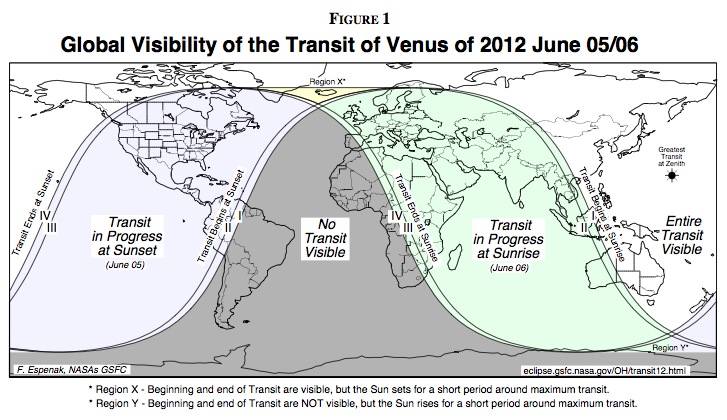
The last Venus transit was in 2004 so the second event of the pair will occur on Wednesday, June 6 (Tuesday, June 5 from the Western Hemisphere). The entire event will be widely visible from the western Pacific, eastern Asia and eastern Australia as shown in Figure 1. Most of North and Central America, and northern South America will witness the beginning of the transit (on June 5) but the Sun will set before the event ends. Similarly, observers in Europe, western and central Asia, eastern Africa and western Australia will see the end of the event since the transit will already be in progress at sunrise from those locations.
For Northern Hemisphere locations above latitude ~67° north, all of the transit is visible regardless of the longitude. Northern Canada and all of Alaska will also see the entire event. Residents of Iceland are in a unique wedge-shaped part of the path (Region X in Figure 1). They will see both the start and end of the transit but the Sun will set for a short period around greatest transit. A similarly shaped region exists south of Australia (Region Y in Figure 1), but here, the Sun rises after the transit begins and sets before the event ends.
The principal events occurring during a transit are conveniently characterized by contacts, analogous to the contacts of an annular solar eclipse. The transit begins with contact I, the instant the planet's disk is externally tangent to the Sun. Shortly after contact I, the planet can be seen as a small notch along the solar limb. The entire disk of the planet is first seen at contact II when the planet is internally tangent to the Sun. Over the course of several hours, the silhouetted planet slowly traverses the solar disk. At contact III, the planet reaches the opposite limb and once again is internally tangent to the Sun. Finally, the transit ends at contact IV when the planet's limb is externally tangent to the Sun. Contacts I and II define the phase called ingress while contacts III and IV are known as egress. Position angles for Venus at each contact are measured counterclockwise from the north point on the Sun's disk.
                                         Table 1

                     Geocentric Phases of the 2012 Transit of Venus 

                            Event         Universal        Position 
                                            Time            Angle

                            Contact I      22:09:38        41°
                            Contact II     22:27:34        38°
                            Greatest       01:29:36       345°
                            Contact III    04:31:39       293°
                            Contact IV     04:49:35       290°
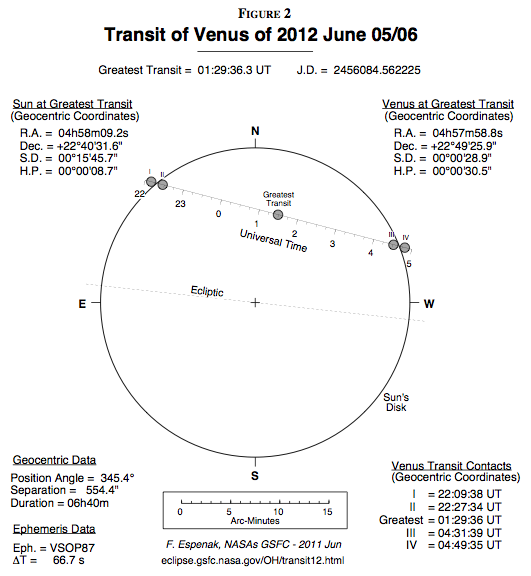
Table 1 gives the geocentric times of major events during the transit. Greatest transit is the instant when Venus passes closest to the Sun's center (i.e. - minimum separation).
During the 2012 transit, Venus's minimum separation from the Sun is 554 arc-seconds (During the 2004 transit, the minimum separation was 627 arc-seconds). The position angle is defined as the direction of Venus with respect to the center of the Sun's disk, measured counterclockwise from the celestial north point on the Sun. Figure 2 shows the path of Venus across the Sun's disk and the scale gives the Universal Time of Venus's position at any point during the transit. The celestial coordinates of the Sun and Venus are provided at greatest transit as well as the times of the major contacts.
Note that these times are for an observer at Earth's center. The actual contact times for any given observer may differ by up to ±7 minutes. This is due to effects of parallax since Venus's 58 arc-second diameter disk may be shifted up to 30 arc-seconds from its geocentric coordinates depending on the observer's exact position on Earth. Table 2 and Table 3 list predicted contact times and corresponding altitudes of the Sun for locations throughout Canada and the United States, respectively. Table 4 provides similar predictions for a number of cities around the world.

Observing the Transit

Since the apparent diameter of Venus is nearly 1 arc-minute, it is just possible to see without optical magnification (but using solar filter protection) as it crosses the Sun. Nevertheless, the planet appears to be only 1/32 of the Sun's apparent diameter so a pair of binoculars or a small telescope at modest power will offer a much more satisfying view. All binoculars and telescopes must be suitably equipped with adequate filtration to ensure safe solar viewing. The visual and photographic requirements for observing a transit are identical to those for solar viewing. Amateurs can make a scientific contribution by timing the four contacts at ingress and egress. Observing techniques and equipment are similar to those used for lunar occultations. Poor seeing often increases the uncertainty in contact timings, so an estimate of the possible error associated with each timing should be included. Transit timings and geographic coordinates of the observing site (measured with a topographic map or GPS receiver) should be sent to: ALPO Transit Section, c/o Dr. John E Westfall, P.O. Box 2447, Antioch, CA 94531-2447, USA.
White light observations of contacts I and IV are not technically possible since Venus is only visible after contact I and before contact IV. However, if Hydrogen-alpha filtration is available, the planet will be visible against either prominences or the chromosphere before and after contacts I and IV, respectively. Observations of contacts II and III also require amplification. They are defined as the two instants when the planet appears internally tangent to the Sun. However, just before contact II, the so-called black drop effect is seen. At that time, the transiting planet seems to be attached to the Sun's limb by a thin column or thread. When the thread breaks and the planet is completely surrounded by sunlight, this marks the true instant of contact II. Contact III occurs in exactly the reverse order. Atmospheric seeing often makes it difficult to measure contact timings with a precision better than several seconds (see "black drop" effect below).

Frequency of Transits

The orbit of Venus is inclined 3.4° with respect to Earth's orbit. It intersects the ecliptic at two points or nodes that cross the Sun each year during early June and December. If Venus happens to pass through inferior conjunction at that time, a transit will occur. Although Venus's orbital period is only 224.7 days, its synodic period (conjunction to conjunction) is 583.9 days. Due to its inclination, most inferior conjunctions of Venus do not result in a transit because the planet passes too far above or below the ecliptic and does not cross the face of the Sun. Venus transits currently recur at intervals of 8, 105.5, 8 and 121.5 years. Since the invention of the telescope (1610), there have only been seven transits as listed in Table 5.
 
                                     Table 5

                            Transits of Venus:  1601-2200 

                           Date       Universal    Separation     
                                        Time

                        1631 Dec 07     05:19         939 "     
                        1639 Dec 04     18:26         524 "     
                        1761 Jun 06     05:19         570 "     
                        1769 Jun 03     22:25         609 "     
                        1874 Dec 09     04:07         830 "     
                        1882 Dec 06     17:06         637 "     
                        2004 Jun 08     08:20         627 "     
                        2012 Jun 06     01:28         553 "     
                        2117 Dec 11     02:48         724 "     
                        2125 Dec 08     16:01         733 "     
                        
The 2004 and 2012 transits form a contemporary pair separated by 8 years. More than a century will elapse before the next pair of transits in 2117 and 2125. During the 6,000-year period from 2000 BC to AD 4000, a total of 81 transits of Venus occur. A catalog of these events containing additional details is available online at:
Additional information on transits of both Mercury and Venus can be found at:

History of Transits

When Johannes Kepler published the Rudolphine Tables of planetary motion in 1627, they permitted him to make detailed and fairly accurate predictions of the future positions and interesting alignments of the planets. Much to his surprise, he discovered that both Mercury and Venus would transit the Sun's disk in late 1631. Kepler died before the transits, but French astronomer Pierre Gassendi succeeded in becoming the first to witness a transit of Mercury. The following month, he tried to observe the transit of Venus, but modern calculations show that it was not visible from Europe. Although Kepler's predictions suggested that the next Venus transit would not occur until the following century, a promising, young British amateur astronomer named Jeremiah Horrocks believed that another transit would occur in 1639. His calculations were completed just a month before the event so there was little time to spread the word. Horrocks and his friend William Crabtree were apparently the only ones to witness the transit of Venus on 1639 Dec 04 which allowed them to accurately measure the apparent diameter of the planet. Unfortunately, Horrocks and Crabtree both died young before reachinbg their full potentials.
Nearly forty years later a young Edmond Halley observed the 1677 transit of Mercury while completing a southern hemisphere star catalog from Saint Helena's Island. Halley realized that the careful timing of transits could be used to determine the distance of Earth from the Sun. The technique relied on observations made from the far corners of the globe. The effect of parallax on the remote observers would allow them to derive the absolute distance scale of the entire solar system. Venus transits were better suited to this goal than were Mercury transits because Venus is closer to Earth and consequently exhibits a larger parallax. Halley challenged future generations to organize major expeditions to the ends of Earth in order to observe the transits of 1761 and 1769.
Many scientific expeditions were mounted but the results were disappointing. The accurate timings needed were not possible due to a mysterious "black drop" effect in which the edge of Venus's disk appeared to deform and cling to the limb of the Sun. Undeterred by the results, another major observing campaign was mounted by many nations for the Venus transits of 1874 and 1882. Again, the "black drop" limited the precision of the observations and the determination of the Sun's distance. Modern analyses show that the "black drop" is the result of seeing effects due to Earth's turbulent atmosphere.
The distance to the Sun and planets can now be measured extremely accurately using radar, so the 2004 and 2012 transits are of minor scientific importance. Still, they are remarkably rare events that were of great value during the early the history of modern astronomy.

Local Circumstances for Transits of Venus

As an aid to historical research, two Excel 97 spreadsheet files have been prepared that can perform calculations for any geographic position. Simply enter the location name, latitude and longitude. Each of the tables then calculates the altitude of the Sun at that location for every contact and for every transit in the table. The two tables are similar but cover different time periods for Transits of Venus:

Transits of Venus: 2000 BCE - 1000 CE

Transits of Venus: 1000 CE - 4000 CE

These files will not open properly with versions older than Excel 97. Each spreadsheet is protected so the user can not accidently delete or edit any information that is required by the calculations. Only the name and geographic coordinates fields (green cells in the spreadsheets) may be modified.

Acknowledgments

The 2012 transit predictions were generated on a Apple Power Mac G4 computer using algorithms developed from Meeus [1989] and the Explanatory Supplement [1974]. Ephemerides for the Sun and Venus were generated from VSOP87.
All calculations, diagrams, tables and opinions presented in this paper are those of the author and he assumes full responsibility for their accuracy.

References

Aughton, P., 2004, The Transit of Venus, Weidenfeld & Nicolson.
Espenak, F., 2002, "2004 and 2012 Transits of Venus", Proceedings for Scientific Frontiers in Reasearch on Extrasolar Planets, PASP.
Espenak, F., 2003, "The 2004 Transit of Venus", 2004 Observer's Handbook of the Roy. Astron. Soc. Can..
Explanatory Supplement to the Astronomical Ephemeris and the American Ephemeris and Nautical Almanac, 1974, Her Majesty's Nautical Almanac Office, London.
Maor, E., 2000, June 8, 2004--Venus in Transit, Princeton University Press, Princeton.
Maunder M. & P. Moore , 1999, Transit: When Planets Cross the Sun, Springer Verlag.
Meeus, J., 1958, "Transits of Venus, 3000 BC to AD 3000", J.B.A.A., 68, 98.
Meeus, J., 1989, Transits, Willmann-Bell, Inc., Richmond.
Newcomb, S., 1895, "Tables of the Motion of the Earth on its Axis Around the Sun", Astron. Papers Amer. Eph., Vol. 6, Part I.
Sheehan, W. & J. Westfall, 2004, The Transits of Venus, Prometheus Books.