Sunday, November 17, 2013

Comet ISON Brightening


Comet McNaught in 2007.  Image credit: Siding Spring Observatory.

Comet ISON continues to brighten.  Check out this article from UniverseToday.com

http://www.universetoday.com/106404/comet-ison-suddenly-brightens-as-it-dives-toward-the-sun/

And here's the link to the Hubble Site blog:
http://hubblesite.org/hubble_discoveries/comet_ison

Thursday, November 7, 2013

'A Tale of Two Seasons'

File:2013 Pacific typhoon season summary.png
Image Credit - Wikipedia.

I read some tropical stats on the 2013 hurricane seasons.  The stark differences are staggering:

Atlantic
Tropical Depressions - 13
Tropical Storms - 12
Hurricanes - 2
Major Hurricanes (Cat 3 or higher) - 0

Eastern Pacific
Tropical Depressions - 21
Tropical Storms - 20
Hurricanes - 9
Major Hurricanes (Cat 3 or higher) - 1

Western Pacific
Tropical Depressions - 48
Tropical Storms - 30
Hurricanes - 13
Major Hurricanes (Cat 3 or higher) - 5

Here's the link to Wikipedia's portal for global tropical cyclones.  They give an excellent summary:
http://en.wikipedia.org/wiki/Portal:Tropical_cyclones

Here's the link to NASA's post on Earth Observatory about Super Typhoon Haiyan.
http://earthobservatory.nasa.gov/NaturalHazards/view.php?id=82341&eocn=home&eoci=nh

Here's another link to s superb summary on Weather Underground:
http://www.wunderground.com/blog/JeffMasters/comment.html?entrynum=2573

Sunday, November 3, 2013

More Nuclear?

Ask an environmental purist about their opinion of nuclear power, and boy will you get an earful.  Nuclear has never rankled me the way it does many.  That being said, great care needs to be exercised with nuclear power especially after the still-unfolding nuclear disaster in Japan.

This article, courtesy of Weather Underground, caught my eye this afternoon...


Nuclear Power Needed to Slow Global Warming?
By: Kevin Begos

Published: November 3, 2013

PITTSBURGH -- Some of the world's top climate scientists say wind and solar energy won't be enough to head off extreme global warming, and they're asking environmentalists to support the development of safer nuclear power as one way to cut fossil fuel pollution.


Four scientists who have played a key role in alerting the public to the dangers of climate change sent letters Sunday to leading environmental groups and politicians around the world. The letter, an advance copy of which was given to The Associated Press, urges a crucial discussion on the role of nuclear power in fighting climate change.


Environmentalists agree that global warming is a threat to ecosystems and humans, but many oppose nuclear power and believe that new forms of renewable energy will be able to power the world within the next few decades.


That isn't realistic, the letter said."Those energy sources cannot scale up fast enough" to deliver the amount of cheap and reliable power the world needs, and "with the planet warming and carbon dioxide emissions rising faster than ever, we cannot afford to turn away from any technology" that has the potential to reduce greenhouse gases.


The letter signers are James Hansen, a former top NASA scientist; Ken Caldeira, of the Carnegie Institution; Kerry Emanuel, of the Massachusetts Institute of Technology; and Tom Wigley, of the University of Adelaide in Australia.


Hansen began publishing research on the threat of global warming more than 30 years ago, and his testimony before Congress in 1988 helped launch a mainstream discussion. Last February he was arrested in front of the White House at a climate protest that included the head of the Sierra Club and other activists. Caldeira was a contributor to reports from the Intergovernmental Panel on Climate Change, Emanuel is known for his research on possible links between climate change and hurricanes, and Wigley has also been doing climate research for more than 30 years.


Emanuel said the signers aren't opposed to renewable energy sources but want environmentalists to understand that "realistically, they cannot on their own solve the world's energy problems."


The vast majority of climate scientists say they're now virtually certain that pollution from fossil fuels has increased global temperatures over the last 60 years. They say emissions need to be sharply reduced to prevent more extreme damage in the future.


(MORE: Leaked Report Predicts Grim Future)


In 2011 worldwide carbon dioxide emissions jumped 3 percent, because of a large increase by China, the No. 1 carbon polluting country. The U.S. is No. 2 in carbon emissions.


Hansen, who's now at Columbia University, said it's not enough for environmentalists to simply oppose fossil fuels and promote renewable energy.


"They're cheating themselves if they keep believing this fiction that all we need" is renewable energy such as wind and solar, Hansen told the AP.


The joint letter says, "The time has come for those who take the threat of global warming seriously to embrace the development and deployment of safer nuclear power systems" as part of efforts to build a new global energy supply.


Stephen Ansolabehere, a Harvard professor who studies energy issues, said nuclear power is "very divisive" within the environmental movement. But he added that the letter could help educate the public about the difficult choices that climate change presents.


One major environmental advocacy organization, the Natural Resources Defense Council, warned that "nuclear power is no panacea for our climate woes."


Risk of catastrophe is only one drawback of nuclear power, NRDC President Frances Beinecke said in a statement. Waste storage and security of nuclear material are also important issues, he said.


"The better path is to clean up our power plants and invest in efficiency and renewable energy."


The scientists acknowledge that there are risks to using nuclear power, but say those are far smaller than the risk posed by extreme climate change.


"We understand that today's nuclear plants are far from perfect."

Tuesday, October 29, 2013

Where were you on October 29, 2012?


Sandy, one year ago...to me it seems that the past year has flown by.  Although, for sure, the weeks in the immediate aftermath of Sandy here on Long Island, NY, seemed to drag on at a snail's pace.  The damage, the disruption, the turmoil, no electricity, the lack of gas, etc., etc., etc....

Here's a link to NOAA's before and after pics as well as some of their additional resources:
http://oceanservice.noaa.gov/news/weeklynews/oct13/sandy-imagery.html

Here's a link to CBS News Radio 880's retrospective (they have other resources on their homepage, too):
http://newyork.cbslocal.com/photo-galleries/2013/10/28/sandy-one-year-later-2/

Retrospectives abound on various other websites.

We remember.  We pray for those still trying to piece their lives back together.  We rebuild.


Wednesday, October 23, 2013

Most Recent Galaxy Yet...

Check out the article below from the W.M. Keck Observatory in Hawaii.  The Observatory hosts largest and most advanced telescopes in the world.
Article and Image Credit - W.M. Keck Observatory

Astronomers Discover Most Distant Known Galaxy

Astronomers Discover Most Distant Known Galaxy
Credit: V. Tilvi, S.L. Finkelstein, C. Papovich, A. Koekemoer, CANDELS, and STScI/NASA
This image from the Hubble Space Telescope CANDELS survey highlights the most distant galaxy in the universe with a measured distance, dubbed z8_GND_5296. The galaxy's red color alerted astronomers that it was likely extremely far away, and thus seen at an early time after the Big Bang. A team of astronomers led by Steven Finkelstein of The University of Texas at Austin measured the exact distance using the W. M. Keck Observatory's Keck I telescope with the new MOSFIRE instrument. They found that this galaxy is seen at about 700 million years after the Big Bang, when the universe was just 5% of its current age of 13.8 billion years.
Astronomers Discover Most Distant Known Galaxy
Credit: V. Tilvi, S.L. Finkelstein, C. Papovich, and the Hubble Heritage Team
An artist's rendition of the newly discovered most distant galaxy z8_GND_5296. (The galaxy looks red in the actual Hubble Space Telescope image because the collective blue light from stars get shifted toward redder colors due to the expansion of the universe and its large distance from Earth.)

Science Contacts:
Dr. Steven Finkelstein
Asst. Prof. of Astronomy, Univ. of Texas at Austin
512-471-1483; mobile 512-517-6122; stevenf@astro.as.utexas.edu
Dr. Casey Papovich
Assoc. Prof. of Astronomy, Texas A&M University
979-862-2704; papovich@tamu.edu
Dr. Mark Dickinson
National Optical Astronomy Observatory
520-318-8531; mdickinson@noao.edu
Dr. Bahram Mobasher
Prof. of Astronomy, Univ. of California, Riverside
951-827-7190; bahram.mobasher@ucr.edu

Kamuela, Hawaii — University of Texas at Austin astronomer Steven Finkelstein has led a team that has discovered and measured the distance to the most distant galaxy ever found, using the W. M. Keck Observatory on the summit of Mauna Kea, Hawaii. The galaxy is seen as it was at a time just 700 million years after the Big Bang. The result will be published in the Oct. 24 issue of the journal Nature.
Initial observations from NASA’s Hubble Space Telescope identified many candidates for galaxies in the early universe, but this galaxy is the earliest and most distant definitively confirmed, using the 10-meter, Keck I telescope fitted with Keck Observatory's newest instrument, MOSFIRE.
What makes this distance so exciting, is “we get a glimpse of conditions when the universe was only about 5 percent of its current age of 13.8 billion years,” said Casey Papovich of Texas A&M University, second author of the study.
Astronomers can study how galaxies evolve because light travels at a finite speed, about 186,000 miles per second. Thus when we look at distant objects, we see them as they appeared in the past. The farther astronomers can push their observations, the farther into the past they can see.
“We want to study very distant galaxies to learn how they change with time,” Finkelstein said. "This helps us understand how the Milky Way came to be."
The devil is in the details, however, when it comes to making conclusions about galaxy evolution, which means astronomers must employ the most rigorous methods and utilize the most powerful instruments to measure the distances to these galaxies in order to understand at what epoch of the universe they are seen.
The Hubble CANDELS survey uses colors from HST images to identify potentially distant galaxies. Finkelstein's team selected z8_GND_5296, and dozens of others, for follow-up spectroscopy from the approximately 100,000 CANDELS galaxies. This method is good, but not foolproof, Finkelstein says. Using colors to sort galaxies is tricky because more nearby objects can masquerade as distant galaxies.
In order to accurately determine the distance to these galaxies, astronomers use spectroscopy to measure how much a galaxy’s light wavelengths have shifted toward the red end of the spectrum over their travels from the galaxy to Earth. This phenomenon is called “redshift", and is due the expansion of the universe.
The team used Keck Observatory’s Keck I telescope in Hawaii, one of the two largest optical/infrared telescopes in the world, to measure the redshift of z8_GND_5296 at 7.51, the highest galaxy redshift ever confirmed. The redshift means this galaxy hails from a time only 700 million years after the Big Bang.
Keck I was fitted with the new MOSFIRE instrument, which made the measurement possible, Finkelstein said. “The instrument is great. Not only is it sensitive, it can look at multiple objects at a time,” he said, which allowed his team to observe 43 galaxies in only two nights at Keck Observatory, and obtain the highest quality observations possible.

In addition to its great distance, the team’s observations showed that the galaxy z8_GND_5296 is forming stars extremely rapidly — producing stars at a rate 150 times faster than our own Milky Way galaxy. This new distance record-holder lies in the same part of sky as the previous record-holder (redshift 7.2), which also happens to have a very high rate of star-formation.
“So we’re learning something about the distant universe,” Finkelstein said. “There are way more regions of very high star formation than we previously thought. … There must be a decent number of them if we happen to find two in the same area of the sky.”
In addition to their studies with Keck, the team also observed z8_GND_5296 in the infrared with NASA’s Spitzer Space Telescope. Spitzer measured how much ionized oxygen the galaxy contains, which helps pin down the rate of star formation. The Spitzer observations also helped rule out other types of objects that could masquerade as an extremely distant galaxy, such as a more nearby galaxy that is particularly dusty.
Other team members include Bahram Mobasher of the University of California, Riverside; Mark Dickinson of the National Optical Astronomy Observatory; Vithal Tilvi of Texas A&M; and Keely Finkelstein and Mimi Song of UT-Austin.

MOSFIRE (Multi-Object Spectrograph for Infrared Exploration) is a highly-efficient instrument that can take images or up to 46 simultaneous spectra. Using a sensitive state-of-the-art detector and electronics system, MOSFIRE obtains observations fainter than any other near infrared spectrograph. MOSFIRE is an excellent tool for studying complex star or galaxy fields, including distant galaxies in the early Universe, as well as star clusters in our own Galaxy.
MOSFIRE was made possible by funding provided by the National Science Foundation and astronomy benefactors Gordon and Betty Moore.


The W. M. Keck Observatory operates the largest, most scientifically productive telescopes on Earth. The two, 10-meter optical/infrared telescopes on the summit of Mauna Kea on the Island of Hawaii feature a suite of advanced instruments including imagers, multi-object spectrographs, high-resolution spectrographs, integral-field spectroscopy and world-leading laser guide star adaptive optics systems. The Observatory is a private 501(c) 3 non-profit organization and a scientific partnership of the California Institute of Technology, the University of California and NASA.

Saturday, October 19, 2013

Clean Air Act - China Style

The following short article appeared recently in the NY Times.  China has notoriously poor air quality.  The article documents new measures put in place to help deal with it.  Thank goodness for our own Clean Air Act of the 1970s.

Amid Heavy Pollution, Beijing Issues Emergency Rules to Protect Citizens

Snappily titled the Six Stops and One Wash, a new and complex string of regulations by the Beijing city government is aimed at combating the effects of persistent, heavy air pollution on the populace. A major rule will take private vehicles off the roads on alternate days, depending on their license plates, when pollution is especially bad.
The new measures were announced Thursday as air in the capital was deemed “heavily polluted,” according to government air quality readings. Air pollution is a chronic problem in large parts of China.
The regulations consist of a system of four colored alerts that will kick in when heavy pollution is forecast.
The World Health Organization’s cancer agency, the International Agency for Research on Cancer, said Thursday that it was classifying air pollution as a Group 1 human carcinogen. Particulate matter, a main component of air pollution, was also being classified as a carcinogen, said the agency, based in Lyon, France. “Our conclusion is that this is a leading environmental cause of cancer deaths,” Christopher P. Wild, the agency’s director, said at a news briefing in Geneva, according to Reuters.
That puts both air pollution and air-suspended particulate matter with more than 100 other known cancer-causing substances in the agency’s Group 1 category, including asbestos, plutonium, silica dust, ultraviolet radiation and tobacco smoke, Reuters reported.
Beijing, along with much of northern China, suffers from consistently heavy air pollution that can be especially bad in the winter, when coal-powered heating systems are widely used.
The plan seems to rest on being able to predict pollution patterns with great accuracy.
When one day of “heavy” pollution, defined as an air quality index reading of 201 to 300, is predicted, a blue alert will be put in place and extra street washing will be carried out. Street washing is intended to hold down the dust that accumulates from things like construction activity and sand from the desert, though some here see it as a mostly cosmetic measure.
A yellow alert applies to one day of “serious” pollution, defined as an index reading of more than 300, and will also lead to extra street washing.
When three days of heavy pollution are predicted, an orange alert will be put in place and more action will be taken: factories will close, work on construction sites will stop, and the use of barbecues and firecrackers will be banned.
A red alert will be put in place when three days of serious pollution are forecast, leading to the full Six Stops and One Wash plan. As well as all the above measures, kindergartens and elementary and high schools will close, and cars will be driven only on alternate days; those with license plates that end in odd numbers can be driven on odd-numbered days, and those with plates ending in even numbers on even-numbered days. Some people can get around this rule, like those lucky enough to have more than one car with the right plates.
Xinhua, the state-run news agency, said this measure will cause about two million more people to squeeze onto public transportation. Extra buses will be deployed, and the subway will run for half an hour longer in the evening, it said.
While the plan has received quite a bit of attention already, with many people sending or forwarding messages with details on Sina Weibo, a Chinese microblog site, its usefulness is already being called into question.
“The target of getting this policy out there is the pollution,” said Manpaozhe Robin on Sina Weibo. “So the point is whether the odd and even car rule will solve the air pollution problem. I don’t believe this is a good policy. It’s a simple and crude measure that leaves the skies still smoggy.”
China has also announced a long-term plan to clear the air, but the government has warned it will not be easy or quick.
Another person, with the user name Jihe de dipan, said: “Starting from today, I will use my mobile phone to follow the air pollution index. Even though we are helpless against the serious pollution that worsens day by day, the least I can do is use my goodness and this record to warn my loved ones and friends to protect their health!” On Thursday, the person noted, “The air pollution level is 285.”
A version of this article appears in print on 10/19/2013, on page A4 of the NewYork edition with the headline: Beijing City Officials Issue Rules to Counter the Effects of Persistent Air Pollution.

Tuesday, October 15, 2013

This Week's Lunar Eclipse


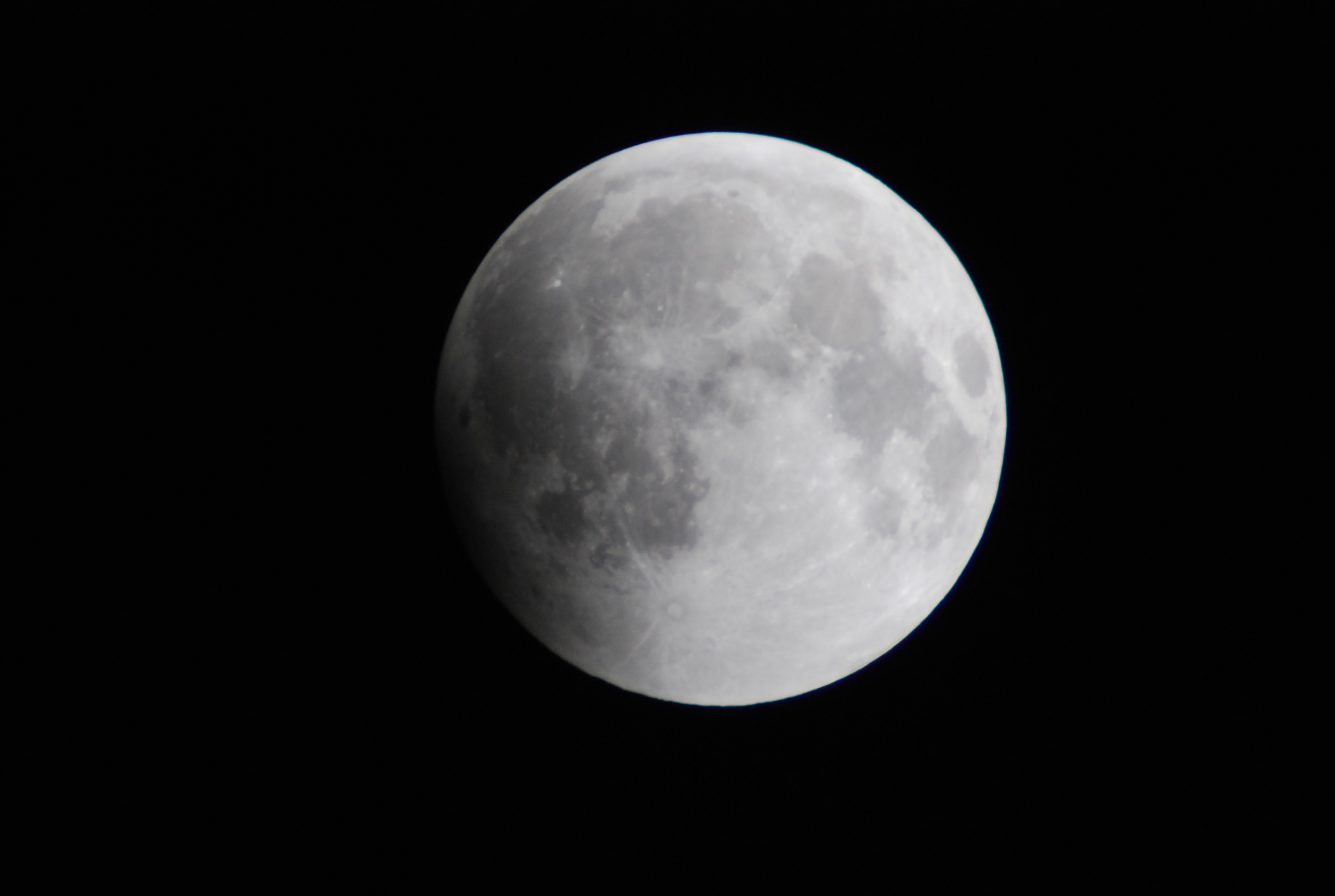
Friday night will be a penumbral lunar eclipse. Here's an excellent summary article from Universe Today.


The December 21st 2010 total lunar eclipse just prior to the beginning of partial phases. The shading on the Moon’s lower limb should be a bit lighter during this week’s penumbral eclipse. (Photo by Author).

You can always count on an eclipse to get you out of a delicate situation. Today is Columbus Day in the United States and Thanksgiving north of the border in Canada. Later this week also marks the start of the second eclipse season for 2013. Today, we thought we’d take a look at the circumstances for the first eclipse of the season kicking off this coming Friday night, October 18, as well as the fascinating role that eclipses played in the life and times of Christopher Columbus.

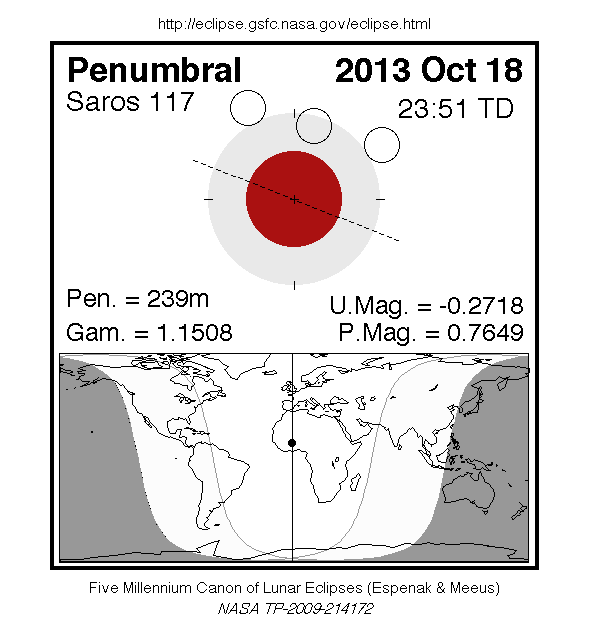
Friday’s event is a penumbral lunar eclipse, meaning that the Full Moon will only pass through the outer bright rim of the Earth’s shadow. Such events are subtle affairs, as opposed to total and partial lunar eclipses, which occur when the Moon enters the dark inner core, or umbra, of the Earth’s shadow. Still, you may just be able to notice a slight dusky shading on the lower southern limb of the Moon as it flirts with the umbra, barely missing it around the time of central eclipse at 23:51 Universal Time/ 7:51 PM Eastern Daylight Saving Time. Friday night’s penumbral is 3 hours and 59 minutes in duration, and 76.5% of the disk of the Moon will be immersed in the penumbra at maximum eclipse.


The visibility footprint and circumstances of this week’s penumbral lunar eclipse. (Credit: Fred Espenak/NASA/GSFC).

Key Events occurring on Friday, October 18th:

21:50UT/5:50PM EDT: 1st contact with the Earth’s shadow.

23:51UT/7:51PM EDT: Mid-eclipse.

01:49UT(Oct 19th)/9:49PM EDT: Last contact. Eclipse ends.

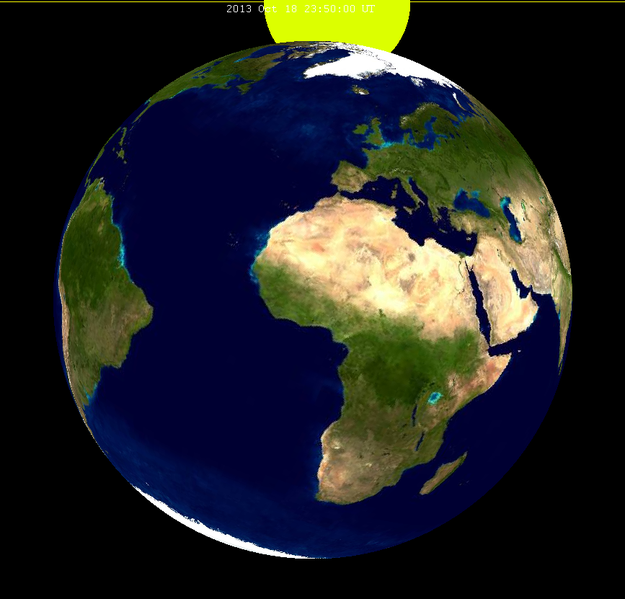
The eclipse will be underway at moonrise for North & South America and occur at moonset for central Asia— Africa and Europe will see the entire eclipse. Standing on Earth’s Moon, and observer on the nearside would see a partial solar eclipse.


A simulation of Friday’s lunar eclipse, looking back from Moon at mid-eclipse. (Wikimedia Commons graphic in the Public Domain).

This eclipse is the 3rd and final lunar eclipse of 2013, and the 5th overall. It’s also the first in a series of four descending node eclipses, including the total lunar eclipse of October 8th next year. It’s also the 52nd eclipse of 72 in the lunar saros series 117, which started on April 3rd, 1094 and will end with a final lunar eclipse on May 15th, 2356. Saros 117 produced its last total lunar eclipse in 1815 and its final partial in 1941.

Though penumbrals are slight events, we’ve been able to notice an appreciable difference before, during and after the eclipse photographically:


Can you spy the difference? The May 18th, 2002 penumbral lunar eclipse before (left) and during mid-eclipse (right). Photos by Author.

Be sure to use identical exposure settings to catch this effect. Locations where the Moon rides high in the sky also stand the best chance of imaging the faint penumbral shading, as the Moon will be above the discoloring effects of the thicker air mass low to the horizon.

The Moon reaches descending node along the ecliptic about 20 hours after the end of the eclipse, and reaches apogee just over six days later on October 25th. The October Full Moon is also known as the Hunter’s Moon, providing a bit of extra illumination on the Fall hunt.

Remove this ad

And this sets us up for the second eclipse of the season the next time the Moon crosses an ecliptic node, a hybrid (annular-total) solar eclipse spanning the Atlantic and Africa on November 3rd. More to come on that big ticket event soon!

In Columbus’s day, the Moon was often used to get a rough fix of a ship’s longitude at sea. Columbus was especially intrigued with the idea of using lunar eclipses to determine longitude. If you can note the position of the Moon in the sky from one location versus a known longitude during an event— such as first contact of the Moon with the Earth’s umbra during an eclipse —you can gauge your relative longitude east or west of the point. The sky moves 15 degrees, or one hour of right ascension overhead as we rotate under it. One of the earliest records of this method comes to us from Ptolemy, who deduced Alexander the Great’s position 30 degrees (2 hours) east of Carthage during the lunar eclipse of September 20th, 331 B.C. Alexander noted that the eclipse began two hours after sunset from his locale, while in Carthage it was recorded that the eclipse began at sunset.


A Jacob’s cross staff, a simple tool for measuring angles in the sky. (Charles Towne Landing Historic Site Museum, Photo by Author).

Columbus was a student of Ptolemy, and used this method during voyages to and from the New World during the lunar eclipses of September 14th, 1494 and February 29, 1504. Of course, such a method is only approximate. The umbra of the Earth often appears ragged and indistinct on the edge of the lunar disk at the start of an eclipse, making it tough to judge the actual beginning of an eclipse by more than ten of minutes or so. And remember, you’re often watching from the pitching deck of a ship to boot!

Another problem also plagued Columbus’s navigation efforts: he favored a smaller Earth than we now know is reality. Had he listened to another Greek astronomer by the name of Eratosthenes, he would’ve gotten his measurements pretty darned close.

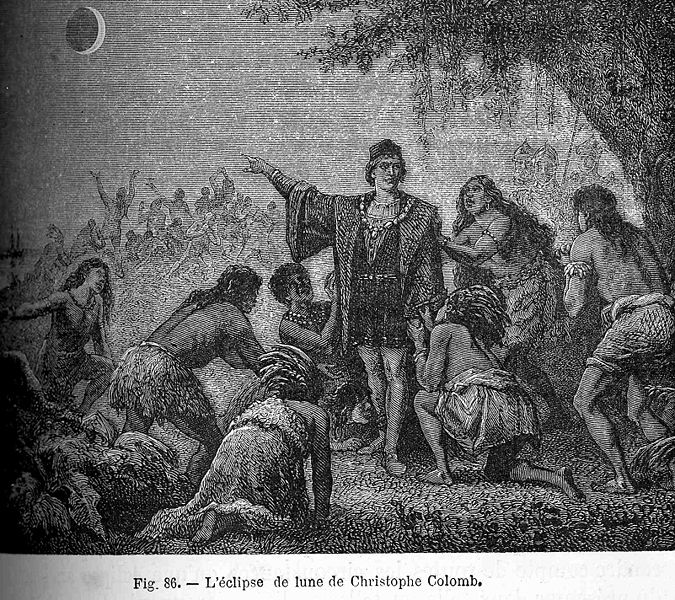
An eclipse also saved Columbus’s butt on one occasion. The story goes that tensions had come to a head between the locals and Columbus’s crew while stranded on the island of Jamaica in 1504. Noting that a lunar eclipse was about to occur on March 1st (the evening of February 29th for North America), Columbus told the local leader that the Moon would rise “inflamed with wrath,” as indeed it did that night, right on schedule. Columbus then made a great show of pretending to pray for heavenly intersession, after which the Moon returned to its rightful color. This kept a conniving Columbus and his crew stocked in supplies until a rescue ship arrived in June of that year.


A depiction of the 1504 lunar eclipse from the 1879 text Astronomie Populare by Camille Flammarion.

Be sure to check out this Friday’s penumbral eclipse, and amaze your friends with the prediction of the next total lunar eclipse which occurs on U.S. Tax Day next year on April 15th, 2014. Can you do a better job of predicting your longitude than Columbus?


Read more: http://www.universetoday.com/105436/this-weeks-penumbral-lunar-eclipse-and-the-astronomy-of-columbus/#ixzz2hqMi3BIA